
Lobbying
How to get the most out of our Lobbying databases
If you want to track influence, you have to track lobbying.
I don’t say that only as a lobbying reporter — although that definitely informs my position — but I believe that to truly understand how influence operates in Ottawa, one has to know who has sway and contacts and how they’re using them.
While not all of the schmoozing that happens in Canada is cleanly written down for journalists like me to peruse, lobbying registries offer insights into the scale and tenor of the conversations that do happen with officials every single day.
Take, for instance, the flurry of lobbying that took place earlier this year around an online safety bill that — at that time — hadn’t even been tabled yet.
Or the fact that U.S. weapons companies were lobbying for changes to federal contracting rules around the time that Canada announced its plans to move away from American arms suppliers.
Or the amount of lobbying that happened related to the Digital Services Tax, which was ultimately defeated in the summer of 2025.
The value of being able to track lobbying meetings came into sharp focus for me when I worked on a story with 17 international outlets from Brazil, Australia, Indonesia, Colombia, South Africa and the U.S. to uncover the co-ordinated, global lobbying efforts of major technology companies to change laws that would have regulated their businesses.
Part of that research included building a database of lobbying activities in each of our countries. In many of my colleagues’ home countries, there is no official public record for lobbying meetings. It required reporters to make phone calls, travel to view government office logbooks and file information requests just to determine who was showing up at public office holders’ meetings.
But thanks to the registries in Canada, and especially to the IJF’s work combining them into central databases, the days it would have taken me to travel to legislative buildings, or the months it would have taken to get back ATIP requests from the federal government, was reduced to a few hours.
The IJF maintains four lobbying databases. Lobbying Registrations, which tracks when an organization indicates its intention to lobby federal officials and the goals of that lobbying, has data from the federal government, nine provinces and one territory. The Lobbying Communications database includes reports of specific instances of lobbyists making contact with public officials, though that data is only tracked for B.C. and the federal government. The Government Funding database lists how much money lobbyists are getting from government. Finally, the Revolving Door database lists former public office holders that have registered to lobby after leaving their government jobs at the federal level, in Saskatchewan and B.C.
One of my favourite stories I’ve worked on relied heavily on the IJF’s lobbying data.
About six months after I started working here, I was thinking about groceries.
The news cycle was focused on the connections between Conservative Party adviser Jenni Byrne’s lobbying firm and Loblaws, at a time when Canadian grocers were being heavily criticized for rising prices.
I wrote a story showing the picture was a bit more complicated than one person with links to both the government and the major chain.
Then, not long after, then-NDP leader Jagmeet Singh was criticized for his connections — via his brother Gurratan — to the Metro grocery chain.
I knew it was nearly impossible that connections ended with a single industry or handful of people.
Politics and lobbying are a network-oriented field. Former public officers who leave to work for an outside lobby firm, or for a company’s in-house government relations team, have unique access to those offices. On a human level that makes sense. People are more likely to answer a call from someone they know — like a former co-worker — than a complete stranger. It gives clients or employers that hire former public servants a significant advantage when they’re making a specific ask from the government.
So, a colleague and I started looking.
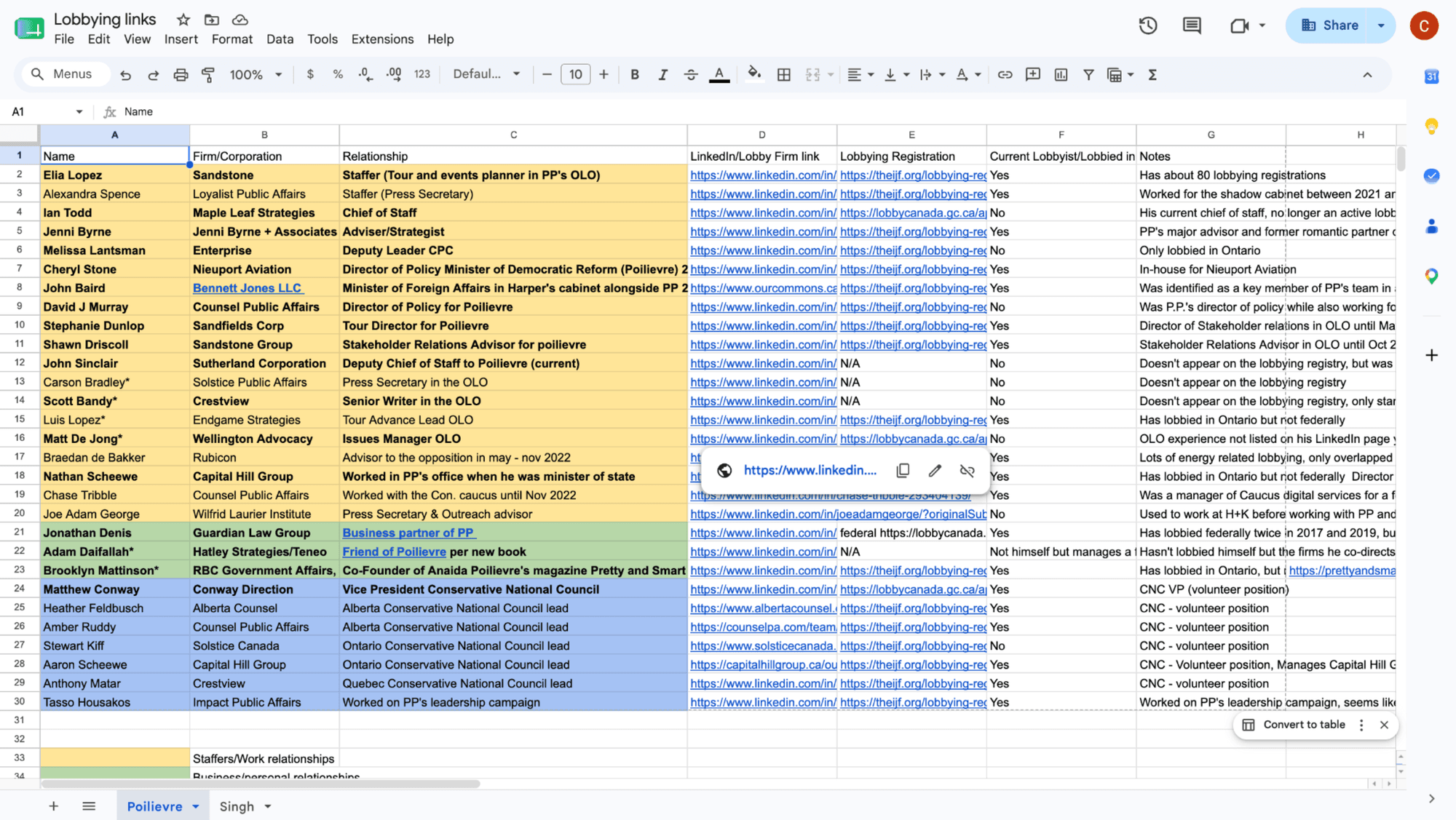
Using LinkedIn and the IJF’s lobbying databases, including Revolving Door, we created a running list of current or former political senior staffers in each of the party leaders’ offices.
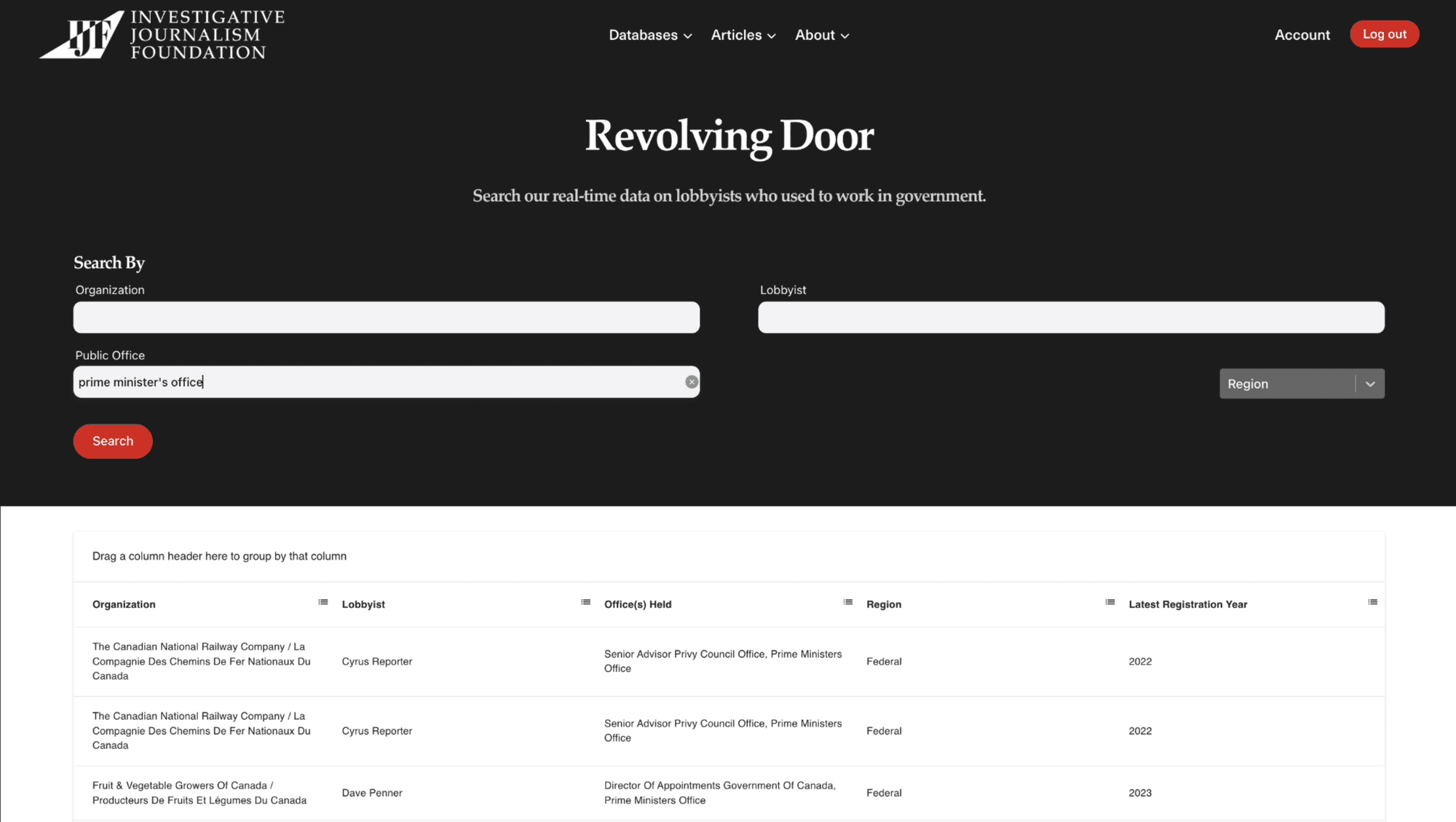
Then we consulted the IJF lobbying databases for each former staffer to find out if they were still actively lobbying, and for what companies.
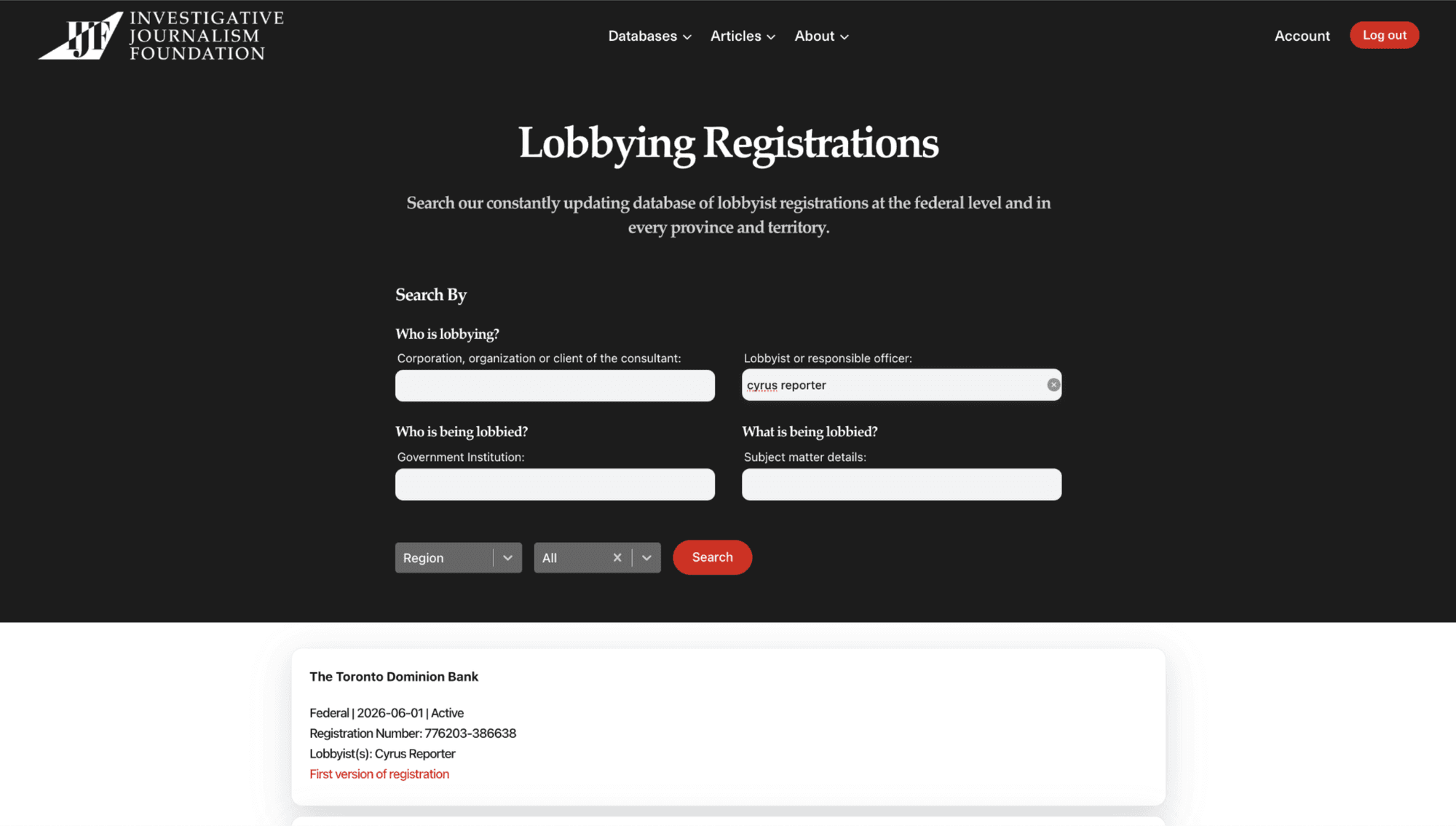
First, we used Lobbying Registrations.
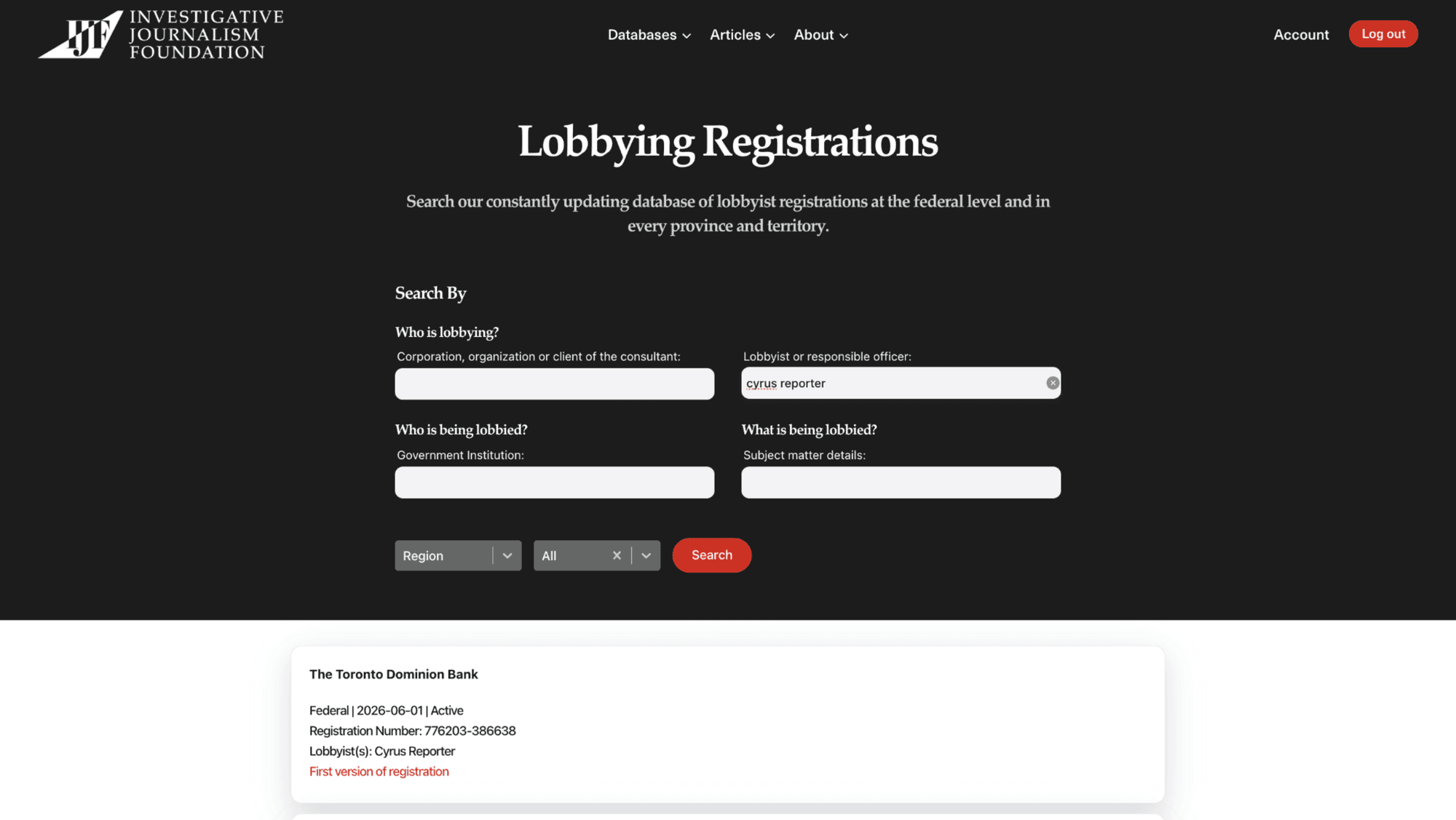
We also checked Lobbying Communications.
After doing weeks of research on LinkedIn and the IJF’s databases, we had a nice little sample to work with.
Once we spoke with some of lobbyists themselves and experts in the field, we built an interactive visualization of how networks in Ottawa operate and what it can tell us.
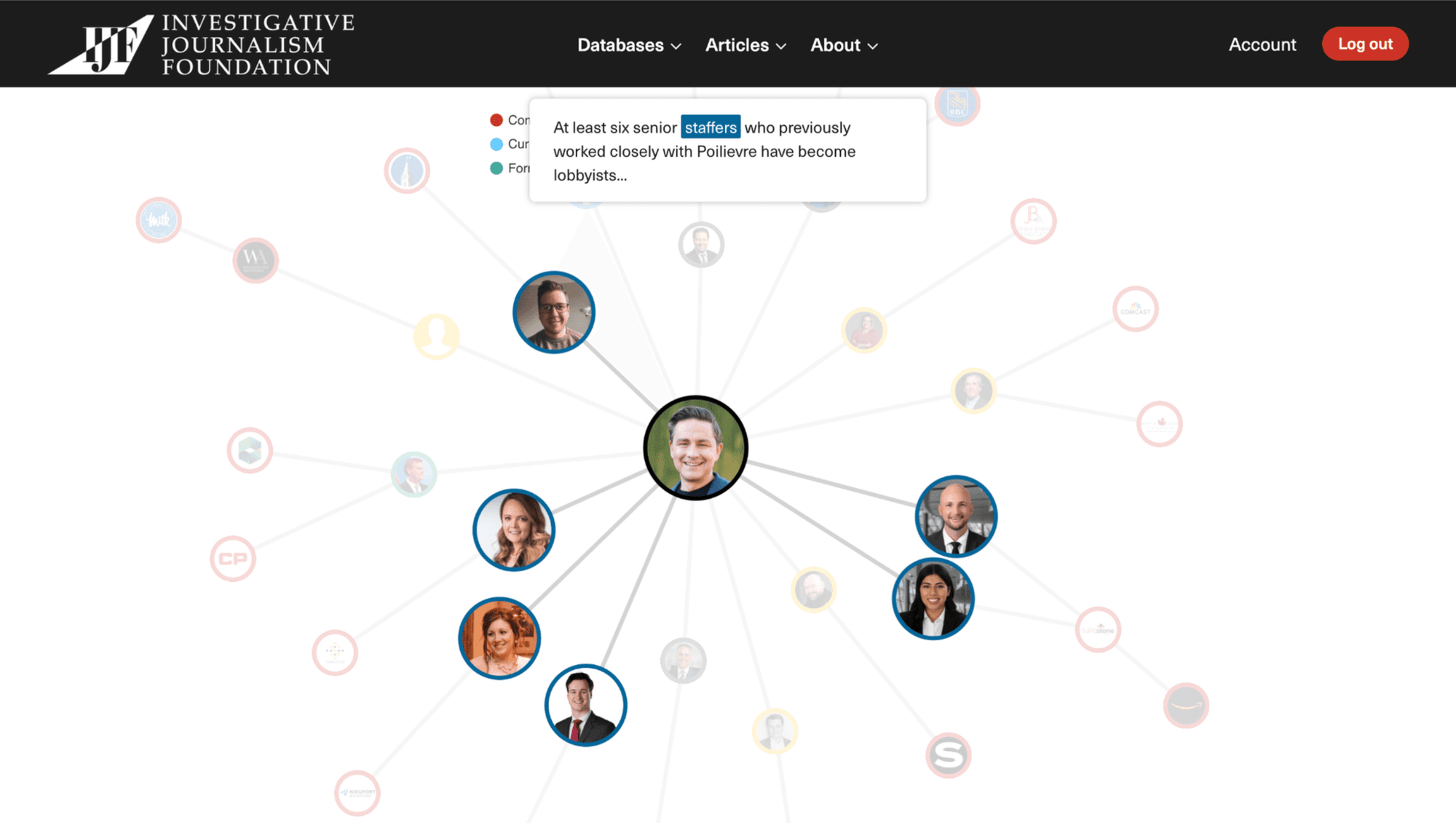
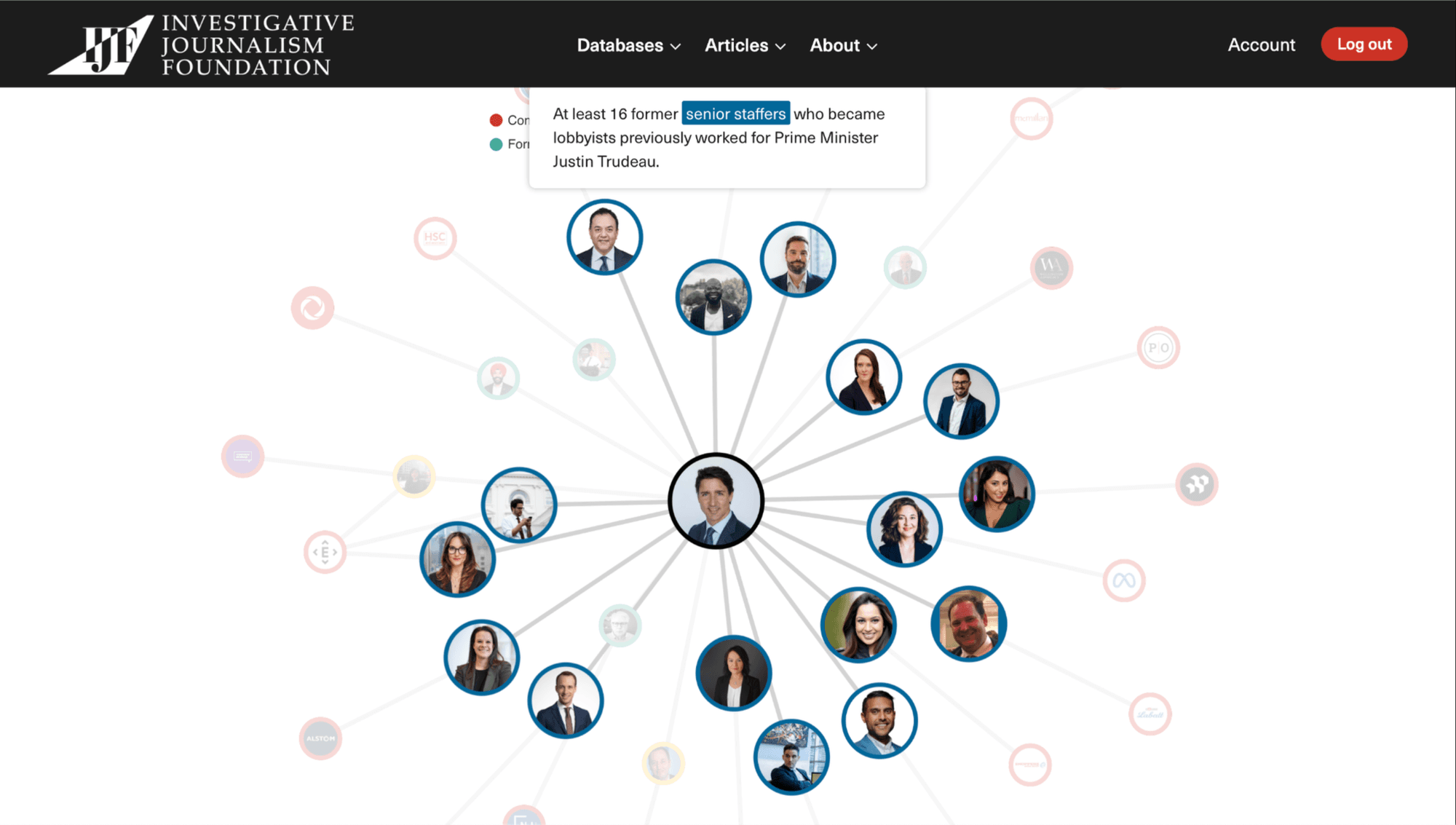
The resulting story, “Meet the lobbyists connected to Canada’s federal party leaders,” was nominated for an Excellence in Data Storytelling award by RTDNA Canada.
Takeaways
Lobbying research isn’t always easy to conduct. It’s messy and inconsistent, but it can help complete a picture of influence, and it’s hiding in plain sight.
The IJF’s databases are here to help simplify the process, to make it possible to conduct a single search to find results from multiple jurisdictions all at once.
But it’s not always foolproof, so here are some things to keep in mind when doing your research:
- If you’re looking for lobbying on a specific topic or issue, try phrasing it multiple ways. For this story, I searched for registrations and communications including the phrases “online harms,” “harmful online behaviour,” “online safety” and “Bill C-63” to find out which companies had registered to discuss the anticipated social media safety bill before it was tabled. Look at previous registrations from stakeholders you know have been advocating on this issue already to find common words and phrases and come up with your search strings.
- Familiarize yourself with the relevant lobbying legislation and guidelines for the jurisdiction you're covering. At the federal level, for example, that’s the Lobbying Act and the Lobbyists’ Code of Conduct. It really helps with understanding how the lobbying system works, what’s illegal, what’s recommended and what guidelines exist for lobbyists and how they can navigate the switch between government work and private sector consulting.
- Lobbying registrations and subject matters are often vague. You can’t always glean what a specific action was about, but asking questions, doing outside research and looking at larger data patterns can be a big help in understanding.
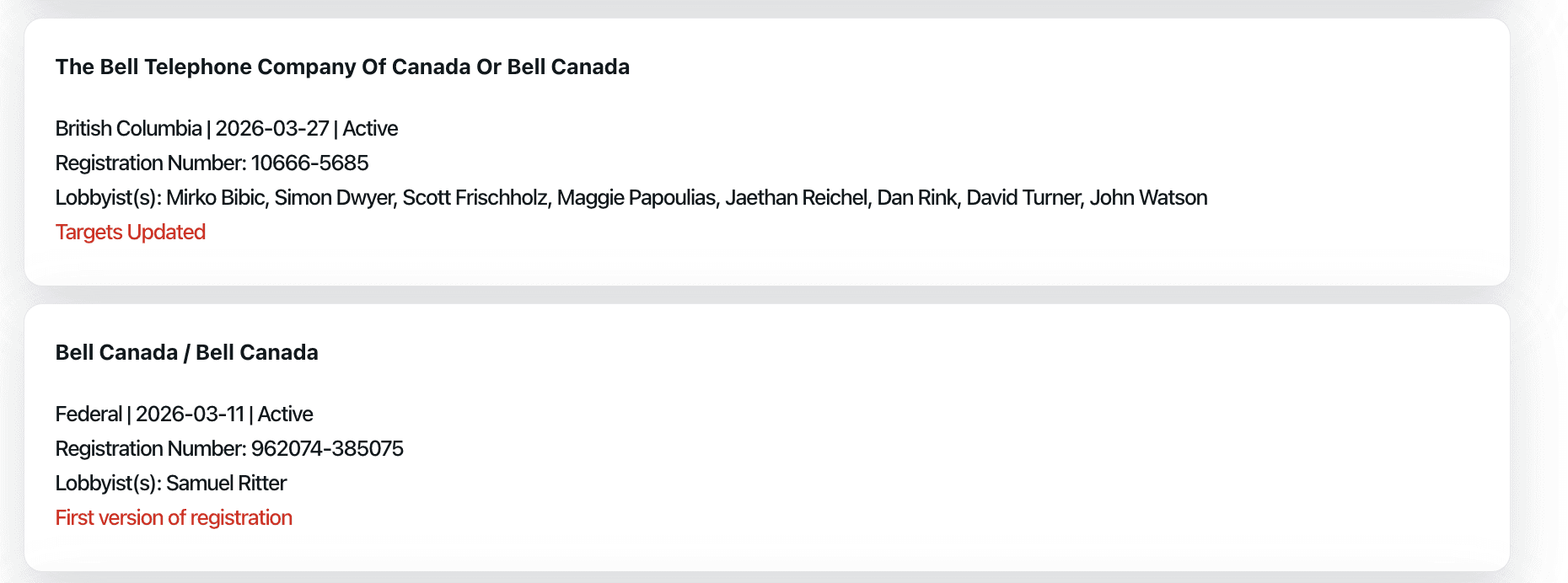
- Big clients often have multiple lobbyists, including third-party consultants and in-house government relations teams. Since each of those lobbyists would file the reports separately, make sure you’re accounting for variations in the company name. Bell Canada can be written as is, or as Bell Telephone Company of Canada or Bell Canada/Bell Canada (the French language translation).

Every lobbying story is different, so take a look around, see what you find and happy searching!
Data for Canadian democracy
The IJF’s databases turn public records into public power. Explore millions of entries on lobbying, donations, contracts, access to information releases and more — and uncover the stories hidden in the data.