
Donations
How to get the most out of our Donations database
By Brett McKay
In the decades since a fictionalized version of the Watergate whistleblower Deep Throat told Robert Redford to “follow the money” in the 1976 thriller All the President’s Men, that aphorism has been adopted by journalists as a mantra and by political observers of all stripes as a go-to explanation for opaque government decisions or any hint of official corruption.
And unlike other wisdom from the cache of political catchphrases, “follow the money” is actually useful advice for making sense of politics. So why don’t more people do it?
As a reporter for the IJF, I’ve spent a lot of time researching the transactional relationships between big political donors, corporate lobbyists and policymakers. By way of an introduction to the IJF’s Political Donors database, I’m going to try and answer my own question and give some tips to help you get the most out of the database.
Is that even legal?
Every province in Canada requires that candidates and parties disclose the names of contributors who give above a certain amount. But if you scratch even this basic statement you start to see how inconsistent these rules are.
Electors in Quebec can donate a maximum annual amount of $100 to each party or authorized candidate in non-election years, and the name, postal code and city of every contributor is recorded and published online. In Saskatchewan, any person or legal entity in Canada can make anonymous donations of up to $250, and for contributions above that limit, only the contributor’s name and donation amount are publicly disclosed.
Like the political financing laws, the ease of navigating government disclosure portals to access contribution data will vary depending on location.
The IJF’s Political Donors database brings all provincial and federal political financing data together in a single search tool. This makes it a great starting point for your research because you can punch one name into the donor search bar and get their entire political financing history going back to 1993.
Tip: The way contributor names are written down can change over time and depending on who is responsible for recording contributor information. You may need to adjust your search terms to find all political donations from one person. For example, the founder of Brandt Industries Ltd., Gavin D. Semple, is a major funder of federal and Saskatchewan political parties. Here’s a look at the results produced by searching variations of his name.
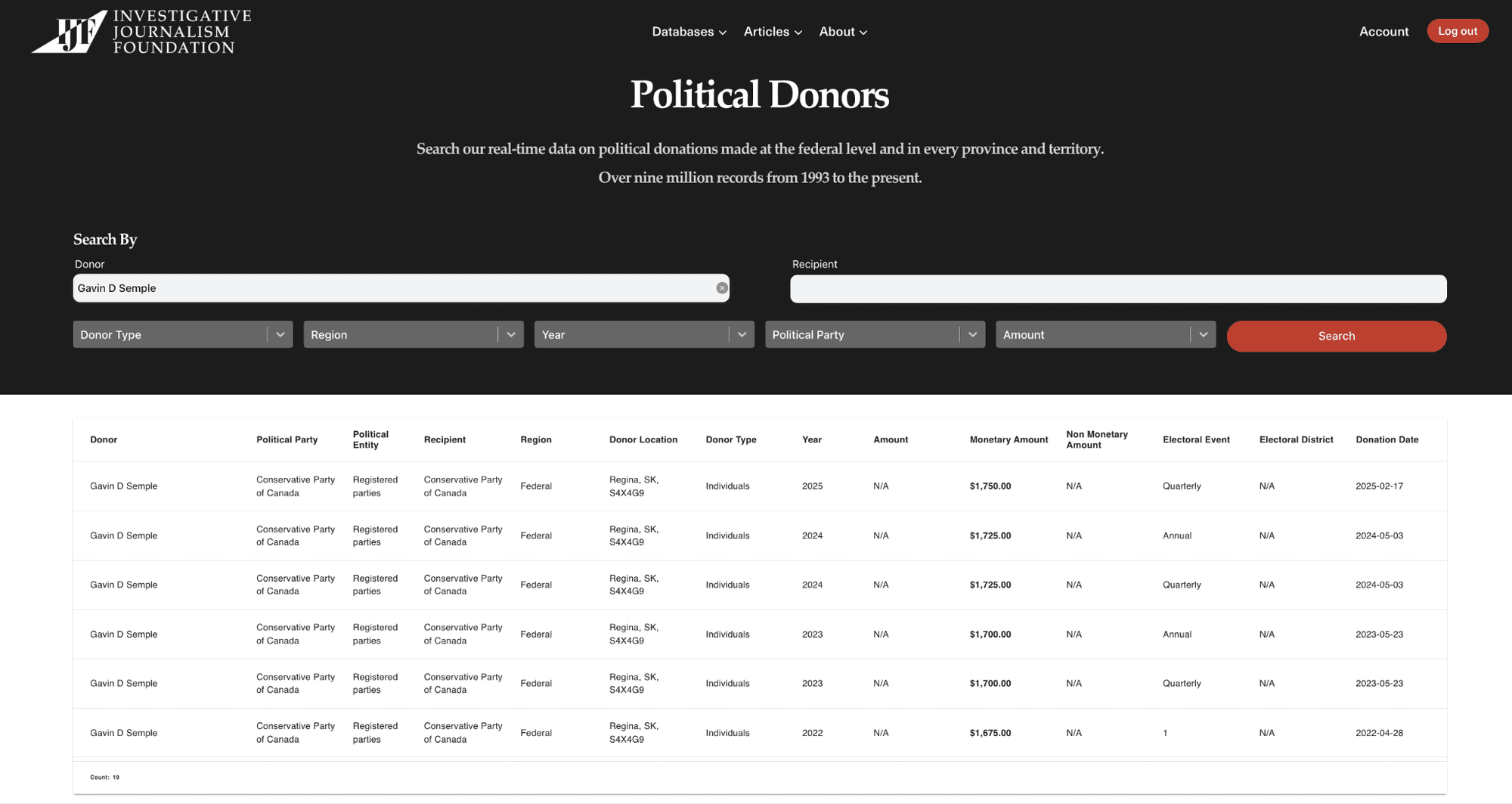
Keep this iterative search technique in mind when looking up corporations. A numbered Alberta company might be entered in the party donor roll as 12345 Alberta Limited, 12345 Alberta Ltd., 12345 Alta. Ltd., etc.
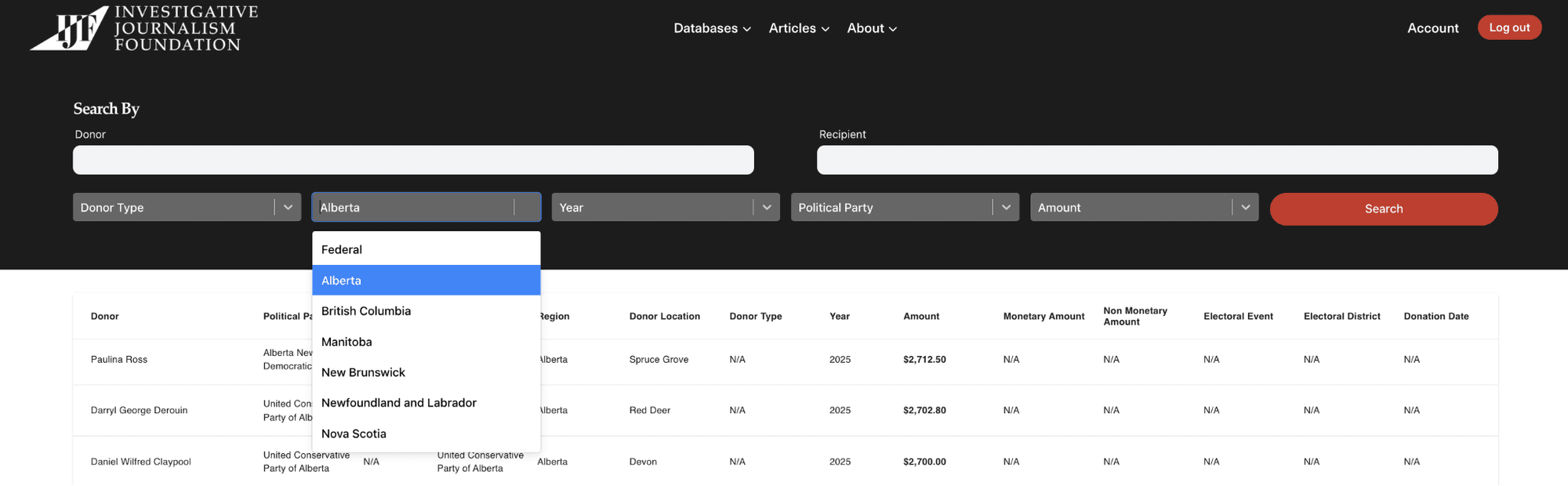
Tip: You can use the region filter to single out a province and narrow down results. The region column also indicates which election regulator is the original source of the data. If you find something worth reporting, this will tell you where you need to go to verify the information or find complete datasets you might require to do more in-depth analysis. To put it another way, the database works best if you think of it as a search engine, not a source material.
There are a few issues mentioned so far that can be hurdles to reporting on political donations. The inconsistency in how data is recorded means additional work is required to verify donor identities. Prior to the IJF’s database launch, going through this data could be (more) cumbersome or time-consuming, and a cross-jurisdictional analysis would have required some skill with web scraping and spreadsheets.
More importantly though, I think the reason political donations are often overlooked in daily reporting is because their influence is undervalued. While everyone loves a story involving an envelope of cash being slipped to a politician to sway their vote, there’s a perception that the regulation of political financing clamps down on quid-pro-quo exchanges, when it’s just as often the case that finance laws open up legitimate pathways for influence peddling.
But to tease these relationships out of a name and dollar amount and to get the most out of our database, you’ll need to combine it with data related to lobbying and procurement.
Cork board and string mentality
The political contributions I’m interested in are an extension of lobbying, and both have the aim of getting government on board with a policy proposal or tipping the scales in the procurement process.
In terms of story generation, one interesting find from any of these areas can be searched in the others, helping to establish a timeline and show co-ordinated efforts and kickbacks.
Beacon AI first came to my attention because in October 2025, Alberta’s government made an exemption to foreign land ownership regulations to allow the majority U.S.-owned company to buy 8.8 square kilometres of land for the construction of five data centres.
A search of political contributions data shows that Beacon AI Centres, also known as Beacon Data Centres, contributed $1,500 to Alberta’s governing United Conservative Party between July and September.
Lobbying filings show that in addition to Beacon’s in-house lobbyists, the company also employed the PR firm Navigator to lobby on its behalf. Returning to the donations database, Navigator and two of its consultants representing Beacon gave the UCP more than $3,600 before September 2025.
For an example starting with donations data, when Elections Saskatchewan published the 2025 financial returns in May, I noticed the for-profit health care company Clearpoint Health Network had donated $5,000 to the Saskatchewan Party.
Clearpoint’s subsidiary Surgical Centres Inc. has been contracted by Saskatchewan’s government since 2012 to perform select publicly funded surgeries. In that time, Surgical Centres Inc. has given more than $35,000 to the Saskatchewan Party.
In October 2025, the company was awarded a new five-year contract, which could be extended up to seven years and total $177 million.
Provincial lobbying records show that Clearpoint lobbied Saskatchewan’s health ministers along with several other ministers and government institutions in 2025, and employed a former senior government staffer to do so.
Rumours and allegations
In a recent interview, Christopher Cochrane, a political science professor at the University of Toronto, described the dangers of not having adequate disclosure of political financing. There’s the increased opportunity for corruption, sure. But the point I want to close on is what he said about the impact on public trust and the conspiratorial rumour mill.
“If people are unaware of how a political party is being funded — who's backing it — rumours can circulate. Allegations can fly. There's no source of evidence that anybody can point to, to say actually, they're not getting funded considerably by this particular group of organizations or this group of individuals,” Cochrane said.
He’s speaking here about the absolute bare minimum of disclosing the names of people who give money to politicians and parties. The lack of meaningful reporting on political donations that makes the connections with the workings of government, I would add, has a similar effect.
Canadians know that our democracy is not an even playing field. Compared to other countries, or to Canada in earlier eras, there’s a lot of publicly available data that can be used to show who enjoys privileged influence. When this isn’t reported, it suggests that these connections aren’t important, and creates a space where unmoored explanations of power networks can flourish, sapping trust in media (and reality) in the process.
Data for Canadian democracy
The IJF’s databases turn public records into public power. Explore millions of entries on lobbying, donations, contracts, access to information releases and more — and uncover the stories hidden in the data.